Tuesday, April 11, 2023

"Tulip" abstract using color wheel


This is a beginner project, but a lot of fun. You will need:

Watercolor paper: Either a quarter sheet or larger; OR, make it in 3 pieces of 9 x 12 paper. (I prefer doing it in 3 pieces)

Your color wheel

Your 6 colors on the split wheel

A cut credit card


The purpose of the project is to make a harmonious painting, using every color in the SPLIT PRIMARY color wheel in order, starting with one color (mine is yellow) and working your way around the color wheel until you return to the same color. It doesn't matter which color you start with or which direction you go around the wheel (clockwise or counterclockwise), as long as you use each color.

A second purpose is to practice a little wet into wet technique. 

If using one sheet of paper, divide the paper into thirds, either with a pencil or a piece of masking tape. This will assure that there will be a balanced number of shapes in each area. IF using 3 separate sheets, you don't need to do that step.

Start at one point in the color wheel (I started with yellow). Make a yellow shape at the far left top. Make a blue  (my green biased blue) shape at the far right top of this third of sheet. (Or the first of 3 pieces of paper.) The middle shape will be green. Then in between you will make a yellow green next to the yellow and a blue green next to the blue. I am going clockwise on the colorwheel. (The reason I did them in this order was to be sure I had enough room for each of the 5 colors needed for that section)

Following my color wheel, in the 2nd, middle, part of my paper,I put a purple biased blue next, a purple in the middle, and magenta (purple biased red) on the far right. I will put a blue violet between the blue and purple, and a red violet between the purple and magenta.

On the final third of my paper, continuing clockwise on my color wheel, I put an orange biased red shape, orange in the middle, and an orange bias yellow on the far right. In between the red and orange I make a red-orange; in between the orange and yellow I make a yellow orange. 

I do this row first to establish generally where colors in the following rows should go.

I try to vary the size and direction of my shapes.

I also try to put them in wet into wet: meaning I wet the paper, add the paint, then drop in a bit of the next color. This is to try to make them visually "connect", as one shape acts as an introduction to the following shape.

You will also notice that, since I want these to look like flowers at the end, I wet the bottoms of some of the shapes to create the beginning of stems.


Continue to make rows of shapes underneath the first, keeping the colors in order, but continuing to vary the size and placement of the shapes. Do this down to about 2/3 or the length of your paper, leaving 1/3 at the bottom.

When you have finished with these shapes you are ready to make "stems." For these you just need a credit card cut up with one end about 1 inch wide. This allows you to make a flexible line.

Mix dark paint of your choosing ( I tried to make my stems a contrasting color to the flowers). Make a thick mixture...not straight out of the tube, but not puddly. The test would be if you tip your palette, the paint should not run. 

Drag the credit card through the thick mixture. Hold it perpendicular to the paper (not at an angle) and draw it down to make a stem. You might want to practice on scrap paper first. But it makes very effect, slightly broken lines.

Make your lines go right over any shapes below it, and go all the way to the bottom of the paper. This will help create depth and connection in your painting.


Below you will see this as three paintings meant to be framed together.
On these I still started with yellow, but went the other way (counterclockwise) on the color wheel. Doing it in three was more playful. As a bonus, I can move these around -- put the red/purple/blue, then blue/green/yellow, then yellow/orange/red-- if I want to change it up. 
You can also see some spattering at the end here.


Here is the split color wheel I followed on each of these.
I only used these 6 paints, creating the secondary and tertiary colors with
only my primaries.


You can start this painting anywhere on the color wheel. If you wanted to start with blue, and go clockwise on the color wheel, you could do French Ultramarine, then blue violet (with more FUM and a little magenta), then violet, then red violet, then magenta; That would be your first third of the paper. Then you would go to Pyrrol Red (or your orange bias red), then red orange, then orange, then yellow orange, then your orange bias yellow (new gamboge on this wheel). You would continue through the yellows and green and end with green biased blue. As long as you use the color wheel to guide you, you shouldn't get lost.

Thursday, March 30, 2023

Color Bias: Split Primary Color Wheel


Below is a previous post on a split color wheel. It contains some links that I don't think are active anymore, but I will check. Please read first:


https://www.blogger.com/blog/post/edit/8812132386157895665/4240977623940030232


When trying to make colors, the emphasis is on color BIAS, not warm or cool. If you think more about what a color leans toward (bias) then it is easier to make the colors you want. 

Here is the color wheel we made today, step by step. Choose your primary colors carefully. You want a distinct difference in your reds (one distinctly magenta, one leaning toward orange, etc.) Placing your colors side by side will help you choose which blue leans toward green, which leans toward violet; which red leans to orange, which look more violet; and which yellow looks orange, which looks lemony. 

For this one I chose Pthalo blue, French Ultramarine; Red Rose and Permanent red: New Gamboge and Hansa Light.  Here is the pattern used. The outer rim is for the split primary, with biases facing each other.  The second circle is for opposite bias.


Step one is to paint in your primaries. I have the green bias yellow (lemony) facing the green bias blue (pthalo--or cerulean or cyan). The orange bias yellow faces the orange bias red on the left.And at the bottom, the magenta--purple leaning red--faces the French Ultramarine, which is a purple leaning (bias) blue.


Step two is to make the secondary colors--green, orange, and violet--from the primaries that have the same bias. So the Hansa light will mix with the pthalo blue to create a pretty green. Make this as perfectly green as you can, not too yellow, not too blue. See where it is places on the wheel. The Orange leaning red will mix with the new gamboge, the orange  leaning yellow, to create as orange a color as you can. Create the violet with the violet leaning red and the violet leaning blue (which face each other on the wheel). Your secondary colors should look really bright and pretty.


Complete the wheel by making a yellow green, adding more yellow to the green mix; and a blue green by adding more pthalo to the green. Do the same for yellow orange and red orange; red violet and blue violet. 


Now to create some mud.

On the second circle, switch the primary colors, so that opposite biases face each other.
(see the picture below)
Make sure you label your colors as you go. You may find out that you'd prefer to change one of your primaries. (ex: Pthalo blue and an orange bias red are practically gray. You might want to use cerulean or cyan instead. Experiment)


Then create your secondaries with the opposite bias colors. (Because you switch places, they will be facing each other on the second ring) Example, you now have an orange bias yellow facing a purple bias green...so the green will be more dull. Oranges, however, tend to still be pretty regardless of bias. Just more flesh colored when the bias doesn't match.


Here is one I made two years ago. When I finished, I took some of my other tubes of color, and tried to find out where they would lie on the color wheel. You can see the little dots with labels after them. 
I also added a cardboard insert to help me find color combinations.


"Swatching" color cards

This is a really useful tool to help you figure out what combinations you can make with just these 6 colors.
I made 12 cards, about 2 1/2 inches by 4 1/2 inches. (I just cut 9 x 12 inch paper into 12 cards). This is from watercolor paper. 

I labeled the two colors at the top. (These may look backward to you, but I am left-handed) The first card you see has hansa yellow light (HL) and Magenta (Mag). I painted a square of hansa mixed with a little magenta to make a yellow orange. I wet the left side with water, and painted the same mix lightly, so that it is a watered down version of that shade.

Then I added a little more magenta to that mix to make as orange a color as I could. Painted it dry on the right (for a strong color); wet the paper on the left, and painted that into the water---same color, but a "tint", or watered down. (it's important to be able to see the watered down version of the colors)

Last, I added more magenta, to make more of a red orange; Painted it dry on the right. Wet the paper on the left. Paint into the water for a tint of that color.

I did that with each combination of yellow and red possible and labeled them.


Here are the purples....


And the greens. 12 cards in all. 


With cards like this, you can take any photo reference and determine what combination of colors you will need to make the colors in your reference. 

It's important to know what you can do with what you have available. A standard, purchased color wheel is very useful, but it doesn't tell you what your paints will do for you.

I also like to do this with my "favorite" colors, those that aren't considered primaries, like quinacridone gold or prussian blue, and see what combinations I can make with those. This helps you to discover what you can make with a more limited palette. It also helps you decide what colors you actually need in your palette. 

There are several good youtubes on split primary palettes if you have the time to look up the subject.

What's HOT and what's NOT?

Color temperature in art is actually based on emotions most people feel on viewing a color.
It is almost directly opposite of science. In science, blue flames are hotter than orange ones.
But in art, orange is considered the hottest color, and the closer you are to orange the warmer you are. Blue is directly opposite, so blue is your coolest color. Both red and yellow primaries are warm.

Where I always waffle is the greens and violets. Most color wheels consider greens cool.
Many consider red violet warm and some consider yellow green warm. It's easier for me to think of bias.
But you will run into many references to warm and cool colors, so it's good to know which are which.

When you are asked to use a "warm" red, that means use one that leans to orange. If you want a cool red, it leans to blue or violet. A "warm" yellow leans to orange. A cool yellow has NO orange in it, but leans to green or lemon. A "cool" blue leans to green, such as pthalo or cyan. A "warm" blue looks a bit more purple in comparison. 


Saturday, February 25, 2023

Rocks and Water--a stream bed

ROCKS AND WATER-a stream in Gatlinburg, TN 


There are many ways to make water effects, but I am going to show how to make rushing water using plastic wrap.

Sketch your picture. Use a wax candle, paraffin, or white crayon to save the whites, especially where you have some foam and at the top of the rocks where the water flows over them.

Wet the water area, keeping the rocks dry. I used cobalt blue as a base color, and then dropped in some violet, turquoise, and some raw umber . While this is wet (shiny, not puddly) stretch some plastic wrap the direction the water is flowing...in this case, horizontally--and lay it over the water area. You can manipulate the plastic wrap a bit to get the ripples you want. Weight the plastic down and allow it to dry on its own for about 15 minutes. (If you remove it too soon, the paint will move and you will lose the effect.)


I treated the rocks as one "formation," painting it all at one time. I started with some ochre, dropped in burnt sienna, some purple for color, etc. , leaving some light areas where the sun would hit. While wet, I lay wax paper over the rocks. The wax paper should be flat, not wrinkled up. The wet paint should hold the wax paper down, but you should put some weight on it until it dries a bit. Again, about 15 min.


Below you can see the painting after the wax paper and plastic wrap have been removed. I've darkened some of the rock where it comes out of the water. The rock on the bottom right is half in/half out of the water. The top edge will get a hard edge, and the bottom edge of the rock will get a softer edge to make it appear to be under the water. Rocks that are totally under water, but visible, will have edges that are a little softer and lighter. 


Next week we'll put in a background and shadows in the rocks and do finishing touches. 


Plastic wrap can make lots of effects. Below I've stretched some over a mix of browns and purples to create a tree trunk or driftwood. Vertically, it could be rugged mountain or cliffs. The green patch is where the plastic wrap is scrunched into a tight ball and set over wet yellows, greens, and blues. It could be the start of a jungle background or garden with dense foliage. 


Simple water with some waves:

Make a graded wash, darker at the bottom, lighter at the top. (Sky is darker at the top, lighter at the horizon; water is usually lighter at the horizon, darker toward the bottom--closer to you)

While damp, make horizontal streaks through the water. In the distance they will be thinner and closer together, disappearing all together toward the horizon. Closer up, the waves will be farther apart and wider. While damp, you can lift a white cap with a thirsty brush. 


Reflections in water. See the link below to another blog on reflections in calm water.


Other types of water on my blogs:

reflections


ripples


sea foam and starfish


Friday, February 17, 2023

Texture methods for painting rocks

INDIVIDUAL ROCKS

In order to show different methods of creating rock, I first drew a cairn (stack of rocks used in national parks, Iceland, and other parts of the world to navigate trails in the wilderness). I made it similar to one of these (photo from unsplash, by Daniel Tellez Cabrere).


There are two or three important things to remember when painting rocks, or any object outdoors. The first is to establish your source of light, and keep it consistent throughout the painting. In this one, I chose to have the light coming from the top left. (See the pretty sun?) That means that surfaces that the light hits directly will be the lightest; areas where no light gets in are the very darkest (like the underside of the rocks). Other areas that do not receive direct sunlight are a medium value.

The second is that you need at least three values --light, medium, dark--to depict a 3D object. There are a lot of other things you can learn about light--reflected light, cast shadows, etc.--but for now, your rocks will be believable if you make sure that you have those 3 distinct values.

Miscellaneous tools used in this exercise were: salt, cut credit card, wax (from candle, crayon, or paraffin), wax paper, alcohol, sponge, and fan brush (or hog bristle brush). Colors used were mostly cobalt (or ultramarine) blue, burnt sienna, ochre, and burnt umber. Keeping it simple.

For the first rock, I just gently rubbed a stick of paraffin onto the rock surface. Then I painted a medium wash of burnt sienna and cobalt over it. When it dried, I darkened the shadow area by adding some burnt umber.


The second rock you see below was the same burnt sienna/cobalt mix with a little ochre to warm it a bit. While shiny, I added some table salt and scratched into areas with the point of a cut credit card. (Other tools can be used to do that) After it dried, I darkened the shadow underneath. Last, I sponged some green over the top left to look like moss.


The next rock also began with cobalt/burnt sienna, but a light wash first. When that was dry, I rubbed some wax over the surface, and covered it with a darker (medium value), and dropped alcohol into it while it was damp. Drops of alcohol create small circles, while streaks of it will push away paint. When dry I darkened the bottom and a little of the right side. Then spattered over dry paint.


This 4th rock was a lot of fun. I made a grayer version of the cobalt/burnt sienna mix just by adding more blue. After adding the initial coat of paint, I spattered into it while the paint is wet. I tore strips of wax paper, and lay it over the wet paint. After it was dry, I removed the wax paper, and got these lovely marks on the rock. After the entire thing was dry, I again darkened the bottom, added some lines for cracks, and did some spatter. I did add a little green moss with the sponge. 


To make this bottom rock, where it meets the grass, I used a granulating paint, like lunar earth, for a medium value. I wet the bottom of the rock, leaving the very bottom 1/2 inch dry, and added dark paint about 1/2 inch above the very bottom. Using a fan brush (or hog bristle brush), I brushed the dark rock color, from top to bottom, over the grass area. That should have created some white grassy looking spaces.

I waited until the shine had gone from the paint, but it was still damp. Using the small flat side of a cut credit card, I pulled out some whites from the paint.

When the rock was dry, I completed the grass effect by painting in some greens just below the rock, and then using the fan brush, brush upward from the green into the whites left on the rock. Leave some of the whites.

I spattered and strengthened some of the cracks with a small brush. 


PAINTING GROUPS OF ROCK

From left to right: Top row: The triangle method; cut wax paper over colorful wash; torn wax paper vertically over wet wash; Middle: negative painting; bottom, rock practice using salt in paynes gray; rock with wet spatter, small grouping using negative painting. 


Mound of rocks using negative painting.
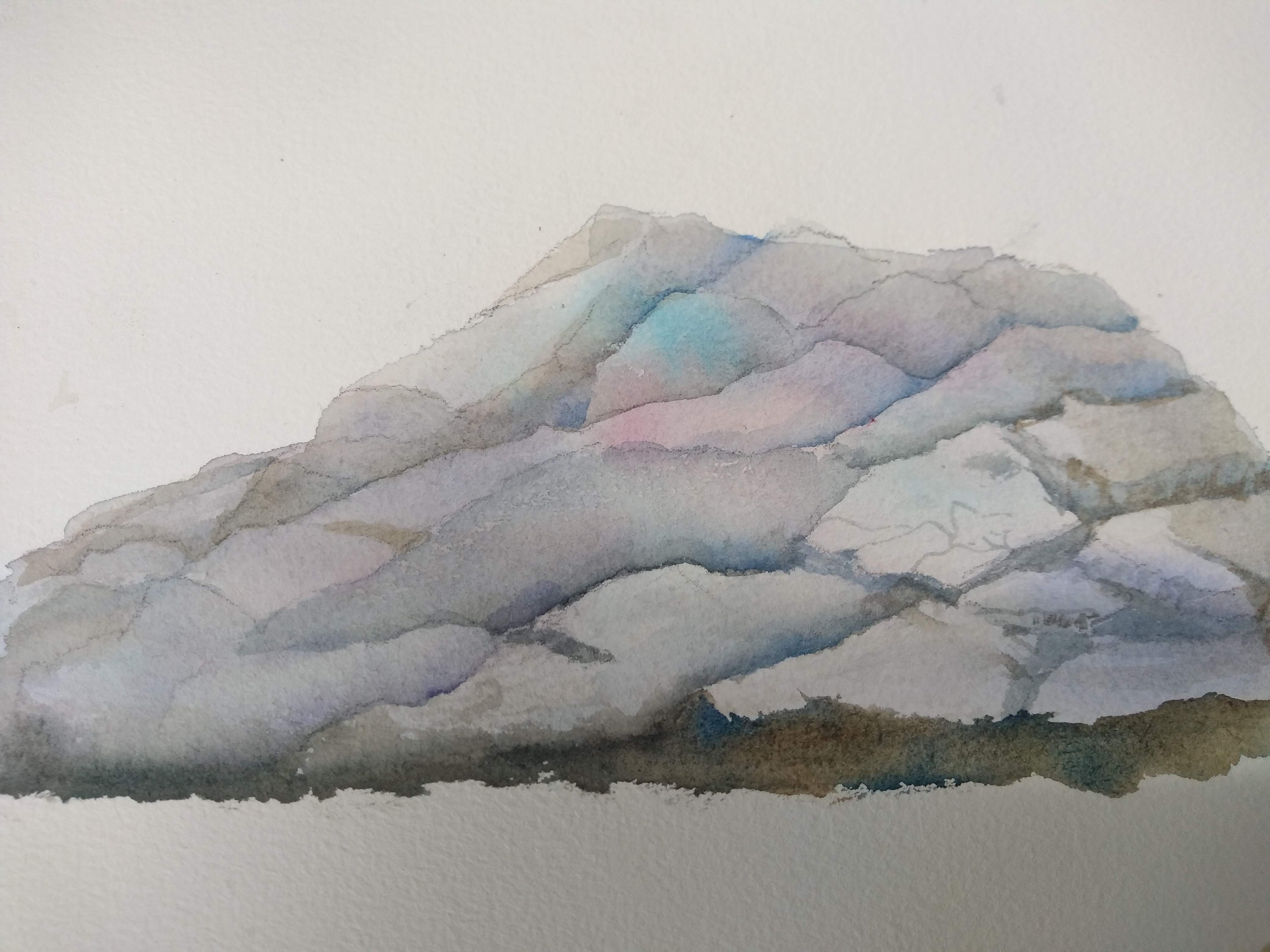
What I like about this method is that you do all your main color and texture at one time.
First paint the entire area with colors you like/see in the mound. You can use wax resist, wet spatter, water droplets, alcohol, or wax paper to create your texture at this point. Dry.


Draw in the rock formations. Then, beginning at the bottom, paint the negative spaces between the rocks. Apply the darkest paint at the bottom of a rock, clean the brush, and gently soften the paint into the rock above. 


Do this with all the rocks, and then add a few details. 


INVENTING YOUR OWN ROCK FORMATIONS

This is a good exercise I got from Joye Moon's book, Exploring Textures.  Gordon MacKenzie has a similar exercise in his book The Complete Watercolorist's Essential Notebook. 
Start by painting triangles wherever you like: long and rounded triangles, big and small triangles.


Paint circles to connect the triangles and identify rock shapes. You can paint more triangles as you go along to fill in rounded shapes. Think of the triangles as shadow shapes where two or three rocks come together. 


Using dry brush or other methods, finish the rocks and contour them. Apply the darkest paint in shadow areas. You can even add small rocks inside the shadows. finish the rock by intensifying forms and shadows.


WAX PAPER CUT

This is a pretty way to make rock forms, especially those you see underwater.
Simply make a wet into wet wash, dropping in colors you like. I did this the same way I did the background for bokeh...in little circles of color. While wet, lay cut circles of wax paper over the paint. It should stick on its own if the paint is wet. Weight them down if necessary. Allow it to dry on its own and remove the wax paper.


Friday, February 3, 2023

Making a Bokeh Painting - Bird Part 1

SECRETS TO CREATING A BOKEH EFFECT 


Bokeh is a photography term used to describe a soft, out-of-focus background. There are often round circles of sunlight in it.

I've tried several different techniques for creating bokeh in watercolor, and have been mostly successful. After watching a Karen Rice method of doing it, I decided to add that to my repertoire, with a few changes.

The two main things I learned were: 

    A. Use only lifting colors (I'll list some of them below)

    B. Apply background colors in circles, wet into wet.  

Step One: Wet the background (shiny, not puddly), and start applying color in circular shapes.


Keep adding colors, also in circular shapes. These are lifting not staining colors. For this exercise, I used veridian, cerulean blue, Hansa Yellow, and Quinacridone gold. 


As it dries, after it has lost its shine but before completely dry, spritz a few drops of water over the paint. 
This is not squirting it to soak it, but sprinkling a few drops on to create small soft effects. (See the little snowy drops?) You can just make drops from the tip of a brush instead. 


Next use a template or stencil with different sizes of circles. You can buy one or you can
use a piece of yupo (or other thin plastic sheet) and punch circles in it. Lay the stencil over
the dried painting where you want a circle. Use a soft sponge (or even a Mr. Clean sponge) to gently lift circles. Blot the area with a paper towel or tissue. Overlap some circles. Don't overdo it. 
Below you'll see some circle stencils (courtesy of Dollar Tree) next to a piece of white yupo and a hole punch. 


Below you'll see bokeh done in different colors, and listing some possible lifting colors you can use. (The ones I used are highlighted)

For Blue:  Cobalt, teal, cerulean, cobalt violet, ultramarine turquoise
For red/orange: Quin. coral, burnt umber, magenta, quin gold, hansa yellow, quin burnt scarlet
(I did use magenta, which is slightly staining, but mixed with all lifting colors, it's OK)
For yellow/orange: Quin gold, hansa yellow, burnt sienna, burnt umber, quin burnt orange, Transparent pyrol orange
For green: Hansa yellow, veridian, hookers green, cobalt blue, cerulean blue, quin gold


Starting to paint the bird


I got this photo reference from Paint My Photo by Chrissy M.(It is a red bellied nuthatch)


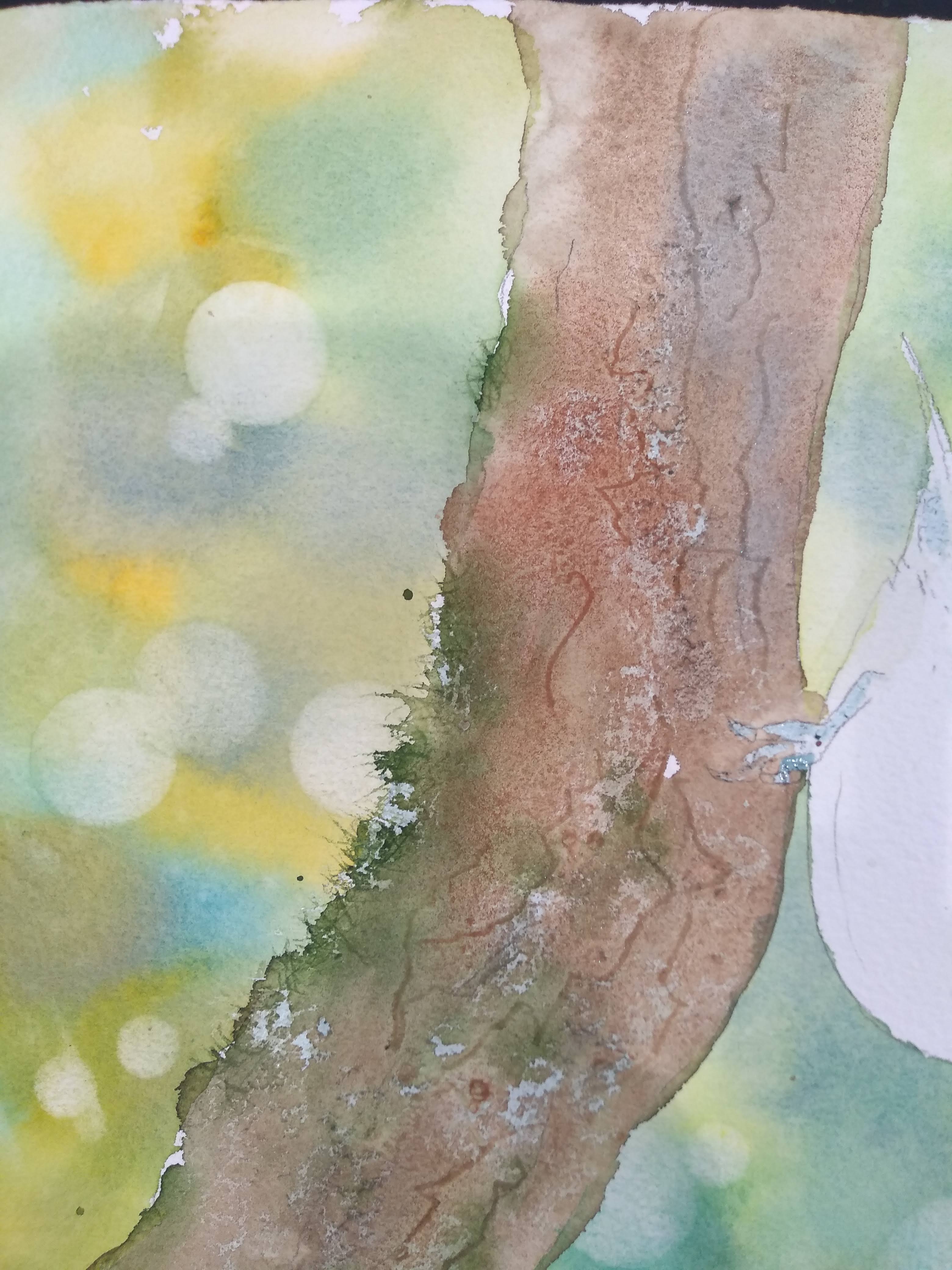
Sketch the bird and tree trunk onto 100% cotton paper. Put small bits of masking on the dot on the eye, the beak, and a few tiny feathers on the wings. (Karen Rice uses a paperclip to make the small liles of masking) Use an old sponge to mask on bits of rough bark up and down the tree trunk. (When the masking tried, I roughed it up by rubbing my finger through it.)

Choose the color scheme you want for the background, and wet the background, avoiding the bird. Do one side of background (beside the tree trunk) at a time, so your paper doesn't dry before you are ready.
Apply the paint as described above. 

DRY the background.

In class I went ahead and demonstrated the bokeh, Using circle stencils in several sizes to lift the bokeh. Overlap some of them. Make some more white and distinct than others to increase the feeling of depth. But I'd prefer doing it after painting the bird and trunk.

TRUNK
Remember, there are patches of miskit on the trunk, roughed up a bit. Don't allow it to be in "chunks," as it needs to look rough for the bark.
I used a mixture of quin gold and ultramarine to create the mossy green. I wet the trunk, then painted in the greens on the left hand side, using the point of a credit card (or other sharp object, like bamboo pen) to pull out strands of green to look like moss. While it was wet, I then painted burnt umber and burnt sienna, allowing it to blend into some of the green. 
 Before it dried, I used the point of a credit card to create some ridges of bark, indenting the paper in ragged lines.

Dry the trunk.
Remove the masking fluid.


There will be some hard edges, which I want, but I don't want the white. Using gray (paynes or neutral tint) or burnt umber, lightly wash over the entire trunk. Drop in darks (greens and browns) to enhance the feeling of bark. 

I went a little further to enhance the feeling of bark, but you don't have to. I painted in some dark, small lines to indicate the bark. I also added some more greens where I thought they got lost. 

Two other things you can do are: scrape areas of the bark with a craft knife blade; and use some pastel in areas to make it look like bark.


THE BIRD

I still have masking fluid on the bird. I used cobalt grayed down with a little burnt sienna for the top of the bird.
I made an underpainting of gray on the belly of the bird, rounding it with some shading. 


After it dried, I glazed over with some orange. I painted the black over the beak and the eye with neutral tint mixed with ultramarine blue. I waited until it was dry to paint the foot. (cobalt blue grayed with burnt sienna)
To finish, I painted in some thin dark feathers and the seed in his mouth. I also deepened the blue on his shoulder and near the beak to round the head a little bit more. 


Before I added the bokeh by lifting circles, I made sure the colors surrounding the bird were the value I wanted. I wanted them a little darker around the belly so that the belly would show up better. It could be a little lighter over the head and back because that area of the bird is darker. If I need to darken an area of the background, I have to do it before I start adding circles.