Thursday, September 21, 2023

Masa Paper Pumpkin Basket

 The reference photo for this was from Jen Green on Paint My Photo. I also had students look at other pictures of pumpkins, gourds, for inspiration for their individual paintings.


I drew this on masa paper. Draw on the rough, not smooth, side. Make sure your pencil marks are dark enough to see. This is different from other papers. You WANT to see your drawing, because, as you wet the paper, the graphite will disappear. (sometimes I have done the drawing with fine pen)

I made several changes. I took out the barn in the background. I wanted to keep it simple so that people could add their own elements--gourds, other veggies, etc. -- to personalize it. 


I began this as I do most of my masa paper paintings: first drawing while it's flat; second, wrinkle and wad up the paper; third, soak the paper. I lay it on a towel to soak up excess water--then on a paper towel while I am painting wet on wet. (A doggie pad is great)

Then I lay in wet washes of color, trying not to get caught up on what object is blue, what is orange, etc.  Usually I begin with one of every primary and let the colors mingle on the paper.


I try to be very free with color, to allow it all to blend together. (you can see how blue got onto two of the pumpkins. I like doing that.)  I only get specific with color if one area MUST be white or yellow. 
I blew it all dry, then started painting some of the positive shapes.


I haven't glued down my work yet. You can see I've improvised on the objects...some small gourds on the bottom left; changing apples and leaves to green gourds in the basket. I do as much painting as possible before mounting on a piece of paper or board. 
This paper tends to "pill", so be gentle with it. I made a field of flowers where the barn was.
Those are made by negative painting greens around spots where there was already some background pinks and yellows (from my original washes.).

YOU HAVE TO DRY the painting each time you want to work on it. Otherwise you will rip it, or the layers will never get darker. 

I noticed that the area of flowers seemed too thick and unyielding. I thought of my stencils
that we used on the printing project. So I lay one of the stencils over the flower area, gently rubbed some damp Mr. Clean sponge, and picked up some new white areas. 


Gluing the painting down:

My favorite glue of choice is YES paste, but you can use matte medium, which is archival, or any white glue if you don't care if it is archival or acid free. Glue it to paper, board that has been gessoed, or your choice. I put glue on the board, then lay the painting over it. Cover it with wax paper, then start pressing it down, beginning at the center and working outward to the ends. 

When it is completely dry, you can continue working on this. Some people prefer to work on it after the bumps are worked out and it feels flatter. You will be able to get some detail work in, or add some pastels  or pen if you like.

After I glued this down, I did a few enhancements with pastel: Highlights on some of the pumpkins; pumping up some of the flower colors; making some straw on the bottom.


John's finished work. I like how the background layer comes through and gives a looser look.
The less you paint on this, generally the better it will look.


Here are some other masa paper projects I've done in this blog:


Sunday, September 17, 2023

Watercolor Canvas


Painting on Watercolor Canvas


Painting on watercolor canvas is completely different from most other surfaces I've used. (This is high quality canvas treated with a ground that accepts watercolor.) The paint sits on top of the canvas instead of being absorbed into the paper, so it stays bright. You don't get backruns. The paint can be lifted over and over again. But I have to admit, it feels weird at first.

I can't say I'd use it for a lot of the things I paint, in particular portraits. But landscapes, sunsets, and still life would be my choices for this.


I made the mistake of buying a PAD of Fredrix watercolor canvas instead of board.


Loose canvas DOES NOT act at all like paper. The minute a brush touches the canvas, it curls and warps. A LOT. It's impossible to paint on.  So...you either have to attach it to a gatorboard .....(see below)...with staples...


Or glue it to some heavy surface. I tried gluing it to the heavy board from the back of an empty watercolor block, and also to some wood board.


To stretch it to a gatorboard, wet the canvas -- I mean soak it for 15-20 min-- and staple it to the board. Dry –you can use a hair dryer.
Or dampen the canvas and glue to a panel with YES paste, or heavy gel, which is more archival. You can also try matte medium, but that won't be as permanent a glue as gel. You will need to flatten it and dry it overnight before using.

*I also tried some of the spray glues....you would not have to wet the canvas before gluing it to a board. It seemed pretty successful, and I didn't have to wait for it to dry.

I purchased the pad because I thought it would be more economical for a class project. (About $22 for a pad of 10 12x16 pieces....about $10 for one 11 x 14 board...and about $18 for a 12 x 16 stretched canvas) So even with the glue and board support, it was still more economical. Just more work than I anticipated.

Watercolor Tips and Tricks from Tom Lynch

Tom Lynch is a watercolor artist who has been experimenting with watercolor canvas from Fredrix for at least 15 years now. Below is a link to several pages of tips to make your experience with canvas a lot easier. (not a video, although you can find some of his videos on youtube)


https://fredrixartistcanvas.com/archives/1874


The ones you most need to remember are:

  1. If you are using a canvas pad, you MUST stretch it onto a gatorboard or glue it to a hard surface. By itself, it buckles and curls too much to be used.

  2. After stretching (or attaching to board) Wipe it down with water and a cloth rag before painting on it. This will also help lighten your pencil lines. Then dry with hair dryer or air dry for 10 minutes.


The first thing you will notice about painting with this is that you can remove paint easily. This is a plus for removing mistakes or making changes; a negative for glazing processes. So if you want to glaze, you have to use a soft brush and very few strokes, otherwise the lower paint layer will lift.

Wet on wet acts a little differently. You still get blends, but it's just different.

You don't have to worry about hard lines that much. They are easy to soften and lift.

It seems to "pill" when you paint on it. That is lessened if you wipe it down with water and a rag before painting. 

FINISHING: After the painting is dry, it should be varnished if you don't want to put it under glass. I use Krylon's Kamar Varnish, which is a spray made for watercolor, acrylic, or oil. To apply it, spray lightly for a first coat. This sets the watercolor. A heavier first coat could rewet the paint and cause it to run or smear. After the first light coat has dried, you can apply one or two more coats. Dry and pop into a frame.

Here are some results from class:


Here is one more result from the board with watercolor ground last week:


How to prepare a regular canvas to use watercolor (using ground)


https://www.youtube.com/watch?app=desktop&v=IOuCvW9Ws88


A short demo of using canvas:


https://www.youtube.com/watch?v=H6LVcnwhdIU


Tom LYnch using wc canvas:


https://www.youtube.com/watch?v=npGvQbCIfPY

Friday, September 8, 2023

Board coated with Watercolor Ground


Watercolor on Watercolor Ground


You can purchase an archival treated board (Ampersand Aquabord) from Dick Blick or other art outlets. However, you can also make your own from a wood board and some Watercolor Ground.

A "ground" is simply a medium that makes a surface capable of absorbing whatever paint you want to use, in this case watercolor. QoR makes a ground, as does Daniel Smith. Daniel Smith makes it in 6 colors: White, Buff Titanium, Transparent, Black, Pearlescent, and Gold. I've used Daniel Smith before, but wanted to try QoR (by Golden) brand. 

A ground like this can be added to many surfaces: wood, glass, plexiglas, metal, mat board, plastic, etc. 
To prepare the wood, I first put two layers of gesso on it. To apply it so that the surface is fairly smooth: Brush it on, then roll it with small sponge paint roller. After the gesso dried, I applied 3 layers of watercolor ground, with the same technique: brush it on, roll with small paint roller, dry completely.
After 3 layers, I dried it for at least 48 hours. (Instructions say 24-48, but I like to be certain it is completely dry.)

Cost-wise, this is much more economical than purchasing aquabord, especially if you have access to a lot of wood. I did 12 8x8 boards with half a jar of ground. I got QoR ground on sale at Blicks for around $12...Amazon also sells it for about $14 for 8 oz. (237 ml) But a jar will make about 20 8 x 8 boards. 


For this project, I wanted students to experience several things: How does it absorb the paint? How well does it glaze? How well does it lift? Can you do wet into wet? The feel of brush against surface is very different than paper.

First, everyone copied the subject with Saral, since you obviously can't use a light box.
Be careful not to smudge or copy too dark. GRAPHITE DOES NOT ERASE WELL on this surface. If you are drawing you can use watercolor pencil, as it will erase with water.

For my reference I used a photo by Stuart Swain from Paint My Photo.

The first technique I wanted to show was how it performs wet on dry. The middle bit of foliage is done first. Using a medium green (like sap) and a dark green (I used green apatite genuine) and a yellow, I applied dabs of paint, alternating the colors and leaving tiny bits of WHITE. It's a very impressionistic method and look.
(If your greens are limited, you can make a medium green look darker and shadowy by adding purple to it.)


You will notice that it doesn't take long for this to dry.


Next I used a flower color (in one I used magenta and violet, and in the one above I used coral and orange). I used the same process, making clusters of flower color, NOT POLKA DOTS. After the flowers dried, I used a lighter green (medium green with yellow) to put in the foliage. I still left tiny bits of white. At the same time, I used the green in a negative painting way to shape the flowers more. Then I added a few tiny bits of darker color in some centers.


The umbrellas used a glazing technique. For each one, I glazed over with a pale shade. (for example, with this first one, I used pale yellow). I dried it. Then I left the first row yellow, then painted all the others pale orange. Dry. Finally, I painted the top section a dark orange, adding in a very dark at the very top.
I did this process with each successive umbrella.


All that is left is a cerulean wash for the sky, lifting some clouds if you want it while paint is wet.
I blushed over the tops of the poles with a wet brush, dragging some of the dark paint over the pole tops. 
(The sun would reflect some of the umbrella color onto the poles) When dry, I shaded the left side of the poles. I used a very fine liner brush to paint in the umbrella ribs. I also shade one side of the umbrella to give a little depth.

I had everyone try to lift some paint. Watercolor lifts easily from the ground. If you only want to lighten a color, just wet the area in the shape you want; if you want it back to white, wet it and blot it to lift. You do not need a stiff brush to lift.

IF I WERE TO DO THIS AGAIN, I would paint in the umbrellas before some of the foliage that goes in front of it so I wasn't having to avoid the greens while I painted. I could have just lifted off parts of the umbrella where I wanted to paint green, since it's so easy to lift)


Positives:
1. Lifts back to white easily. Therefore, easy to correct mistakes. And the lifting does not damage the surface, so I can paint over it as much as I like. 
2. Colors sit on top a little more, so look vibrant.
3. You can do some glazing, as long as you use a soft brush and don't accidentally lift the lower layer of paint.
4. You can take the entire board back to white, but not over and over again.
5. You do not need to mat or frame under glass. You can just use a spray varnish (like Kamar) to protect it.

Negatives:
1. Pencil marks do not erase.
2. Sometimes it is TOO easy to lift.

Below is the painting on regular paper.  Since this painting is so small (8x8) I didn't do some of the shading and details I might have if it were larger.

Thursday, August 24, 2023

Gel Print Photo Transfers

 I have to admit, this is one of the most frustrating processes I have tried. The Youtubes make it look so easy! But there are so many variables:  type of paper, type of paint, type of gel press (hand made or manufactured), weather, humidity, etc. And not every magazine will make a successful transfer. So it can be very frustrating. But when it's successful, it's like magic. (When really, it's science)

I'm going to attach two youtubes about photo transfer, since they explain the process better on video than I can with words. But I also want to talk about my experience, which might help you.

PREPARING A PHOTO TO TRANSFER

What works best is a photo copied on a LASER printer that has very distinct value changes. Black and white seems to work better than color. The white of the paper will suck up the paint and the darks will tend to resist the paint, leaving the darks on the plate and lifting off the paint where it will be light. The carbon from the laser print is responsible for this reaction.

I took photos that I thought would work, put them in my Notanizer ap, and turned them into two value notans. I printed them in 5 x 7, which seems to be more successful than some of my larger tries.

Here are some examples of the original photo with the Notan version:


PAINTS

Some seemed to work better than others. I had more luck with heavy body paints.
One night I couldn't get anything to work. The next day I realized the problem: it was hot outside, we had the air conditioning on, and the ceiling fan was just four feet above where I was working, which caused the paint to dry out before I could get a successful print. I even tried the open acrylics, but they also dried in these circumstances. 

You need to use a dark paint. I found black, brown, and even red worked pretty well. And purples.

You need to use a light coat. This takes practice on these image transfers. Too much paint, and it's a mess. Too little paint on the plate , and it dries before it can transfer. 

The videos show the artist putting dabs of paint directly on the plate and then smoothing it out with a brayer. But sometimes, the paint seemed to be not as evenly covered in some spots. So you might try putting the paint on your brayer first (on the side) and then putting it on the plate. 

GEL PLATE

The homemade plate is a bit stickier, but I had just as much success on it as I did with the purchased plate.
However, the purchased plate, which is harder, seems to have a smoother surface, while the homemade plate tended to get little imperfections in it.


PRACTICAL STUFF

I used white butcher paper underneath the gel plate to keep it clean and to provide a white surface to see color better. Much easier clean-up.

Use baby wipes and hand sanitizer to keep the plate clean when you are finished or between colors.

Make a "register" to help you line up your prints. It should be the same size as your print paper.
I lay mine underneath the white butcher paper, and I can see through it. This is especially helpful if you are doing extra layers on the first print, and want to line it up.  This one shows 3 sizes: 5 x 7, 8 x 10, and 8 1/2 by 11.


Below are some of the more successful prints:

Brown heavy body paint; homemade gel plate; on copy paper


Brown heavy body acrylic; homemade gel plate; copy paper


red heavy body acrylic; Gel Press brand plate 8 x 10; copy paper


purple heavy body paint; Gel Press plate; on Watercolor paper


Brown heavy body paint; 5 x 7 purchased gel plate; card stock


Here are the video instructions:

Froyle Art


More from Froyle Art...some fun ideas


7 minute video with some extra elements: Nitsa Creative


Sunday, August 20, 2023

Monoprinting on Gel Plate


Gel plate printing has been around a while, but I am just now "discovering" ways to use it. People use it to create papers for scrapbooking and collage, and just as an interesting stand alone piece of art. It is also used for photo transfers, which I'll talk about in the next blog.

Gel printing requires a gel press (plate) which you can make or purchase. There are a variety of mediums you can use: any type of acrylic, water color, or inks. (Inks, however, tend to stain the plate).

You can purchase one, about $26 from Amazon for an 8 x 10


https://www.amazon.com/gp/aw/d/B01GOO7HL0/?_encoding=UTF8&pd_rd_plhdr=t&aaxitk=ea6c0f85b52da5c799e1a9eab234998e&hsa_cr_id=3439662520801&qid=1692557393&sr=1-2-9e67e56a-6f64-441f-a281-df67fc737124&ref_=sbx_be_s_sparkle_mcd_asin_1_img&pd_rd_w=tixmo&content-id=amzn1.sym.cd95889f-432f-43a7-8ec8-833616493f4a%3Aamzn1.sym.cd95889f-432f-43a7-8ec8-833616493f4a&pf_rd_p=cd95889f-432f-43a7-8ec8-833616493f4a&pf_rd_r=H3YJ8CWJ64G19100JVJD&pd_rd_wg=Qbekg&pd_rd_r=1445ac36-9499-4ea6-9b14-102c519c7a2a&th=1


Making your own is possible and cheaper. I tried it using the following directions:

https://www.google.com/search?q=make+your+own+gel+plates+youtube&rlz=1CATRIY_enUS965&oq=make+your+own+gel+plates+youtube&gs_lcrp=EgZjaHJvbWUyBggAEEUYOTIHCAEQIRigAdIBDjEwMjQ3NjUwNGowajE1qAIAsAIA&sourceid=chrome&ie=UTF-8#fpstate=ive&vld=cid:efa94072,vid:sfifEFKjP7s

Here is The Frugal Crafter's version. You'll see lots of versions, some with alcohol, some with all glycerin. Hers is a bit cheaper bc glycerin is more expensive than alcohol.

https://www.youtube.com/watch?v=h9taUh073vQ

The hardest part for me was removing it from the mold. If you have a nice silicon mold it will remove easier. I ended up taking my large one and cutting it up into smaller sizes. The 5 x 7 size will probably be most used in making cards. The larger sizes for making backgrounds for paintings.

Generally you use one with a brayer, acrylic paints, and stencils or other items to make impressions into the paint on the plate. You don't want to have very thick paint. Apply it with a brayer; add stencil on top; put your paper on top of it all and rub gently with your fingers. (Rubbing with fingers on a stencil gets more of the paint between the spaces of the stencil.) Then remove the paper...don't leave it on for a long time. 

The first technique we tried was to brayer on different types of acrylic and use a stencil, print; then remove the stencil and print a "ghost" print. The top print is on regular copy paper with a stencil; the one below is after removing the stencil from the plate.


Below is inexpensive craft acrylic on tissue paper--first with the stencil on the plate; second after removing the stencil to get a ghost print.


Below is inexpensive regular acrylic used with stencils.


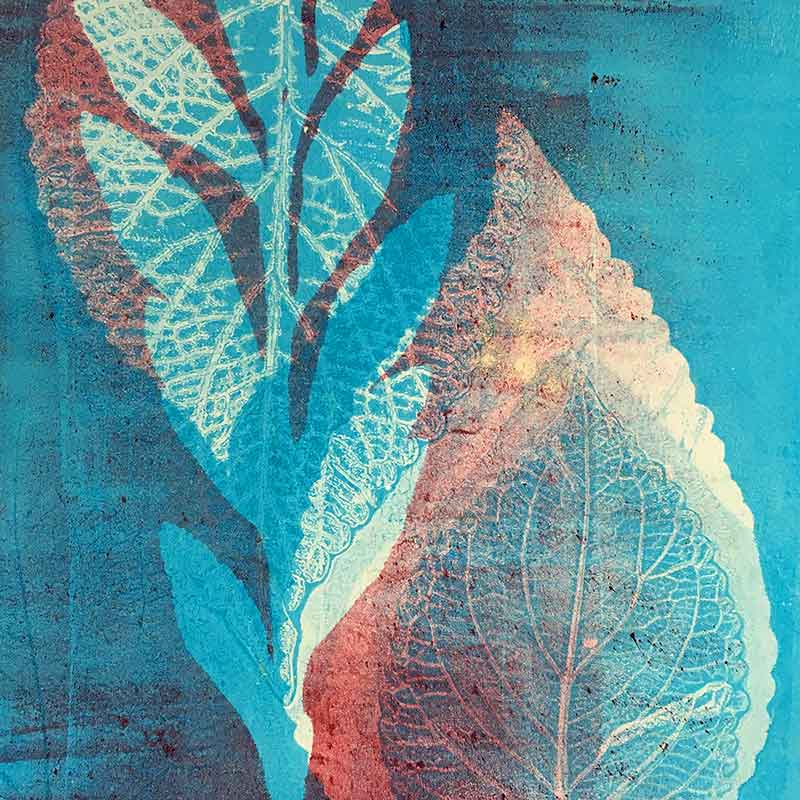
Below is on copy paper with leaf impressions.


You can purchase stencil or templates or "impressables" to use with gel plates.
You can make your own stencils easily by cutting them out of yupo or cellophane. You can use natural vine, leaves, plant parts. You can create texture with bubble wrap, saran wrap, baby powder, burlap, or anything you can think of.

Of all the paints we tried, I like the cheap-o craft paints for most things. But if I want to take my time to create textures, the open acrylics allowed more drying time.

Other than the gel plate, the supplies are simple. You need a brayer to apply the paint; paper towels to wipe excess paint from the brayer; some kind of paint or ink; any kind of paper you want to experiment with; and baby wipes or hand sanitizer to keep the gel plate clean. 

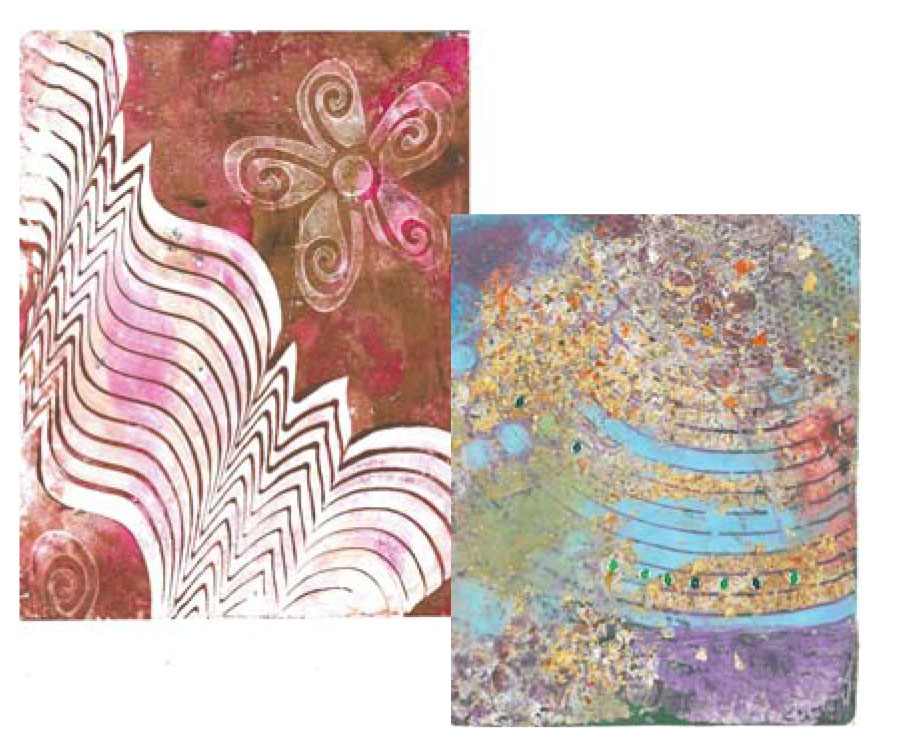
Below are some examples (from the internet, not mine) of ideas to use.


Kim Herringe, printmaker 


This tells what types of paints/inks to use, and emphasizes NOT to use glossy or printer paper.

Sunday, August 13, 2023

Monoprinting with Watercolor made simple


Monoprinting with watercolor

A monoprint is just what it says...mono, meaning one. You get one print from your plate, sometimes one or two "ghost" prints, which are lighter and pick up less paint.

Why do a monoprint, when the whole point of "printing" is to get multiple images from one plate?

Let's look at the process before I answer that.

Supplies you need are very simple, and you probably have around the house:

1. A clear "plate": that could be plexiglas, stretched plastic wrap, glass, yupo, or, as I've used here, a cheap cutting mat from the Dollar Tree.

2. Tube watercolors

3. A small brush, not too soft or floppy

4. tray of water

5. towel

6. a pile or tablet of inexpensive newsprint

7. printing papers....this can be watercolor, card stock, masa, or just about any paper you want to try.

8. A drawing to set under the plate.

9. Alcohol to clean the plate.

When I used plexiglas, I "roughed" it up a bit using steel wool. I need a plate that is slick enough to release the paint but with enough tack to hold the paint on until ready to print.


Step one: Clean the plate with alcohol to get rid of any oils that might keep the paint from sticking.
Step two: Put your drawing underneath the clear plate and tape it to the back.

Paint directly onto the plate using watercolor straight from the tube. Little or no water.
Allow it to dry completely. You can dry on a cool blow dryer if needed.

Cut the paper you want to print on to the size you want. Soak paper in a tray, then place inside a towel to absorb excess water. You want it wet, but not shiny.

Open your tablet of newsprint and set your painted plate inside.


Lay the damp paper over the painted plate, and gently pat onto paint.
Close the tablet and gently rub with your hand to encourage the paint onto the print paper.
You CAN use a brayer, but sometimes it puts too much pressure and smears the paint.


Your first print should be very colorful. Textures depend on what paper you have chosen to print on. We used print paper, copy paper, rice paper, and masa paper.
Below is the first print on the left. Second or "ghost" print in the middle; third ghost print on the right.


If you have letters or numbers on your picture, remember they will be printed backward, so you will have to paint them in reverse.

Here is a blue bird that I did a monoprint of.


Sunflowers on inexpensive watercolor paper and on card stock.


Cowboy Bob


Monoprinting on Yupo

In spite of the fact that paint on yupo slips and slides, it's not as much as on a plexiglas. So you CAN prepare a print on it without going directly from the tube, as long as the paint is fairly thick.
You can do it just as you would on plexiglas, but you can't see through it (unless you get the transparent kind), so you might have to draw first.

But there's another way to do this. You can cover your entire piece of yupo with paint and let it dry.
Then, using water and a fine brush, remove paint to create whites. 


Then continue to paint in details where you want them. 


Use the same process for wetting and blotting your paper and rubbing to make the print come off.
A brayer works on this better than the other kind for some reason. 

Below you can see the painted yupo, the first print and the ghost print .


So back to the original question...Why would you bother to do a monoprint?

Some people use it to experiment quickly with color combinations before they commit to a larger more complicated piece. You can use it to make cards that you want to be original. You don't have to keep drawing it over and over again, because the drawing is taped to the back of the plate, and you can always see it. 

A monoprint can be an original unique piece of art itself. You can easily make changes on it by wiping mistakes off the plate with water. and can use it without a drawing to be completely expressive. You can use it for the base of a pen and watercolor painting, especially some of the ghost prints. 
 Also, you can use extremely inexpensive materials. You don't need super high quality watercolor paper to get an attractive result